What Does It Mean if Your Blood Pressure Reading Is 58/32?
Depression diastolic blood pressure is a risk gene for new-onset heart failure in older adults. UAB cardiologist Jason Guichard explains why that might be, the causes of low diastolic pressure and how to bargain with it.
Written by: Matt Windsor
Media contact: Adam Pope
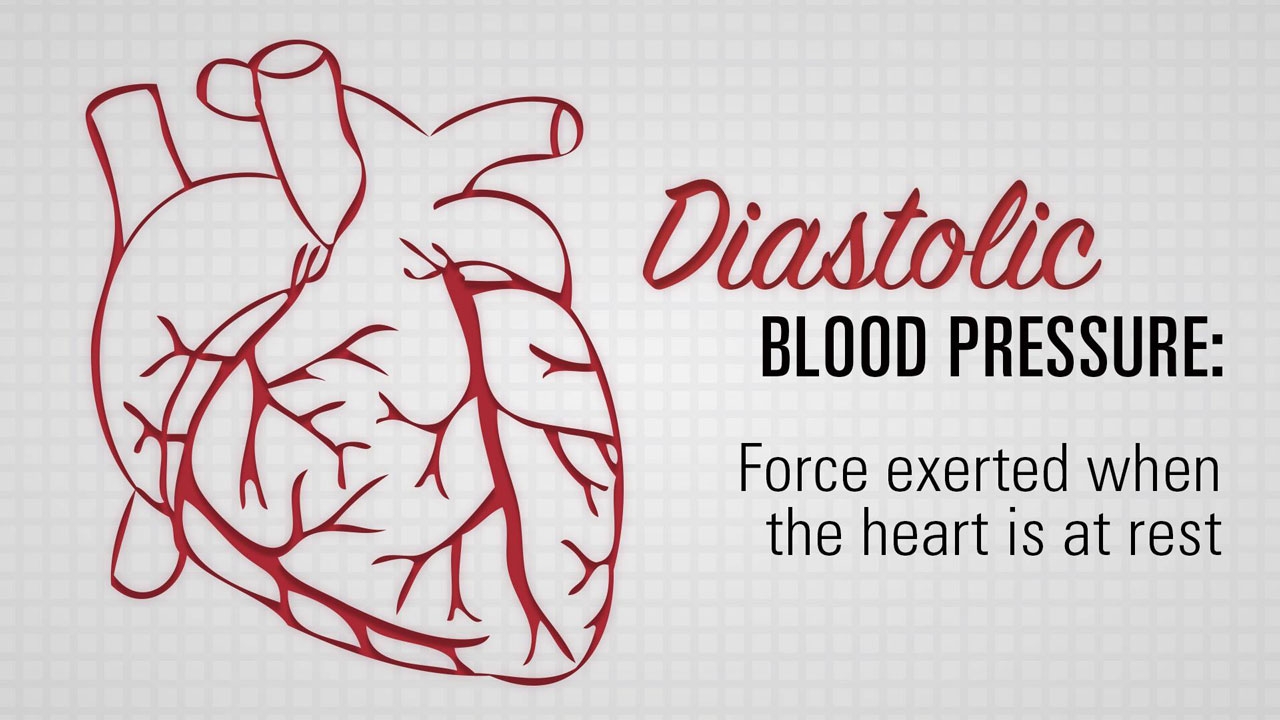
Claret pressure consists of two numbers. Systolic force per unit area, the force exerted on claret vessels when the centre beats, is the upper number. Diastolic pressure, the strength exerted when the heart is at residual, is on the bottom — in more than ways than ane. Systolic pressure attracts the lion'due south share of attention from physicians and patients, says UAB cardiologist Jason Guichard, G.D., Ph.D.
"Physicians are busy people, and like it or not they frequently focus on a single number," Guichard said. "Systolic blood pressure level is the focus, and diastolic pressure is almost completely ignored." That is a mistake, he argues. "The majority of your arteries feed your organs during systole. But your coronary arteries are unlike; they are surrounding the aortic valve, so they get blood only when the aortic valve closes — and that happens in diastole."
Diastolic pressure has been getting more attending lately, however, cheers in part to an influential paper in Hypertension, written in 2011 by Guichard and Ali Ahmed, K.D., then a professor of medicine in UAB'due south Division of Gerontology, Geriatrics and Palliative Care and at present the associate master of staff for Health and Aging at the Veterans Affairs Medical Middle in Washington, D.C. (Ahmed remains an adjunct faculty fellow member at UAB.)
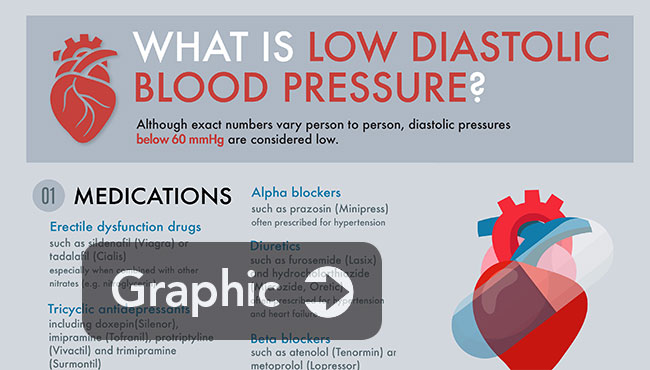 INFOGRAPHIC: See our quick guide to causes, and treatments, for depression diastolic claret pressure.
That paper coined a new term, "isolated diastolic hypotension," which refers to a low diastolic blood pressure (less than lx mm Hg) and a normal systolic force per unit area (above 100 mm Hg). Older adults who fit those conditions are at increased chance for developing new-onset eye failure, the researchers found.
"High blood pressure is a problem, but low claret pressure is also a problem," Guichard said. That realization helped bulldoze a 2014 determination by the console members appointed to the Eighth Joint National Committee (JNC viii) to relax target claret pressure level guidelines for those over threescore years old. [Read Guichard'due south accept on "ideal blood pressure" and the new guidelines in this blog post.]
"Years agone and until recently, doctors were treating blood pressure so aggressively that many patients couldn't even stand without getting dizzy," Guichard said. "We want to empower patients to know that yous don't have to drop those numbers all the way down to zippo, to the point where you can't play with your grandkids or play golf game or take a simple walk around the block because your claret pressure level is then depression. I retrieve it'due south important to raise awareness in this area, especially for older people."
 Jason Guichard Ahmed and Guichard are continuing to explore the mechanisms behind low diastolic pressure level in more particular. Several new papers are pending, Guichard says. In the meantime, he sat down with The Mix to explain the dangers associated with depression blood force per unit area.
Nigh people are trying to lower their claret force per unit area. What would y'all ascertain as "too depression," and why is that a trouble?
A diastolic blood pressure level of somewhere between 90 and 60 is good in older folks. One time y'all start getting beneath 60, that makes people feel uncomfortable. A lot of older folks with low diastolic pressures get tired or dizzy and accept frequent falls. Obviously, none of that is good news for people who are older, who potentially have breakable bones and other problems.
Your coronary arteries are fed during the diastolic phase. If you have a low diastolic pressure, information technology means you have a depression coronary avenue pressure, and that ways your heart is going to lack claret and oxygen. That is what we call ischemia, and that kind of chronic, low-level ischemia may weaken the heart over fourth dimension and potentially lead to middle failure.
What could cause a person to have low diastolic claret pressure?
Medications are a big ane. There are some medicines that are culprits for lowering your diastolic blood pressure level more your systolic — specifically, a grade of medications called alpha blockers, or central acting anti-hypertensive agents.
Some other reason is age. Equally you lot become older, your vessels become a little more stiff, and that tends to raise your systolic pressure and lower your diastolic pressure.
It's difficult to opposite the crumbling process; merely one potential therapy is to find ways to permit your vessels to retain their elasticity — or, if they've lost it, possibly ways to gain that dorsum.
The best current treatment is to lower dietary table salt intake, which has been shown to be very closely linked with the elasticity of your vessels. The more than salt y'all consume, the less elastic your vessels volition be. Most peoples' salt intake is too high. Common salt intake is a highly debated topic in medicine, but most believe that dietary salt intake of greater than 4 grams per twenty-four hour period is as well loftier, and less than 1.five grams per twenty-four hour period is too low. This depends on a person's age and underlying medical problems, simply this range is a proficient dominion of thumb. In that location is some data that the ideal table salt intake for salubrious people is effectually 3.half-dozen grams per day, but once more this is highly debated.
UAB'due south hypertension group, led by Dr. Suzanne Oparil and Dr. David Calhoun, has detailed much of the basic scientific discipline showing the outcome of common salt at a molecular level in the blood vessels. On the inside, your blood vessels are lined with a sparse monolayer of endothelial cells. In an experimental setting, adding salt to these cells causes changes almost immediately. They get less reactive — that means they stiffen up — and lose their elasticity, which is what you actually encounter clinically.
Additionally, the stiffening of the vessels happens very soon after you take on a salt load during eating, which is very interesting.
Beyond changes in medications, what can people do to raise their diastolic pressure if it's likewise low?
Lifestyle changes like nutrition and exercise tin accept firsthand furnishings. Your within changes much quicker than the mirror shows yous. On the inside, you're getting much more salubrious by eating better, getting exercise, decision-making your weight and not smoking.
Everyone thinks, "I'm going to have to exercise this for six months or a year earlier I see any changes." That'due south not true. The torso is very dynamic. Within a few weeks, you can meet the benefits of lifestyle change. In fact, with dietary changes in salt intake, you can see a difference in a day or two.
If someone does have low diastolic force per unit area, what should they — and their doctors — look for?
If they aren't on medications that we could conform, the of import affair is shut monitoring; possibly seeing a patient more oftentimes in clinic and monitoring them closely for cardiovascular disease or heart failure symptoms.
Your original study in Hypertension got a lot of attending. What are you working on now?
Nosotros're finalizing some papers that address two large criticisms of that study. The showtime criticism was that nosotros were looking strictly, as the name suggests, at isolated diastolic hypotension. Nosotros didn't really care at the time what the systolic pressure was doing; but a high systolic pressure is a hazard for heart failure, amid other things. When nosotros looked at the patients in our report, their systolic claret pressures were all relatively normal, and nosotros adjusted for patients with a history of hypertension.
So we actually went back and redid the analysis, completely excluding people with hypertension. And the results still remained true. In fact, the association was even stronger.
The other criticism involved something called pulse pressure level. That's the deviation between your systolic and diastolic claret force per unit area. And multiple studies have shown that a widened pulse pressure level is also a hazard factor for cardiovascular affliction. Some fellow researchers said, "Really, all y'all're looking at is but a wider pulse force per unit area. This isn't necessarily novel — that's been shown earlier."
So nosotros've actually looked at pulse pressure differences in all these patients and broken them down by differences in pulse pressure. And even when we adjusted for pulse pressure, the conclusion almost the low diastolic pressure still rang true.
Nosotros actually looked at three different groups of pulse pressure — normal, wide and really wide. And it was true throughout. Low diastolic blood pressure increased one'due south gamble for heart failure.
You besides have an interest in diastolic center failure. What is that?
In that location are two dissimilar types of heart failure: one where the pumping function of the heart is abnormal — that is known as systolic center failure — and one where the relaxation office is abnormal — that is known every bit diastolic heart failure. We accept lots of medicines for, and feel treating, systolic heart failure, which is also called "heart failure with reduced ejection fraction" — everything from beta blockers, ACE inhibitors and ARBs to mineralocorticoid receptor antagonists and statins.
Diastolic heart failure, or "heart failure with preserved ejection fraction," has no approved pharmacologic therapies to engagement. Information technology was widely overlooked, to be honest, until about 10-fifteen years ago, when physicians realized that these poor patients were having terrible middle-failure symptoms but none of the classic objective measures of heart failure. In nigh cases, you tin't even tell the difference betwixt a person with systolic and diastolic heart failure based on their symptoms. On the inside, notwithstanding, their heart is pumping merely fine; the problem is their heart is stiff — it doesn't relax equally well as it should. That stiffness leads fluid to back up into the lungs and extremities and causes a lot of the symptoms that yous have with systolic centre failure, but the pumping role of the heart is normal.
At present that at that place is an awareness of diastolic eye failure, we're realizing that it is a very common problem. It looks like there are as many people with diastolic center failure as with systolic heart failure. As a matter of fact, there may even exist more people with diastolic center failure.
It has become a heavily studied form of heart failure right now. Everyone is clamoring to become a medicine to help these patients, because it turns out to be very prevalent, and a lot of times they have the same morbidity and mortality equally people with systolic eye failure.
Make an appointment with a UAB md
Source: https://www.uab.edu/news/research/item/10393-diastolic-blood-pressure-how-low-is-too-low
Belum ada Komentar untuk "What Does It Mean if Your Blood Pressure Reading Is 58/32?"
Posting Komentar